AMD Ryzen 5 5500X3D Benchmark Leak: Budget AM4 Gaming CPU
AMD continues to release processors for its long-running AM4 platform, giving existing PC owners another way to upgrade without replacing their motherboard and DDR4 memory. The Ryzen 5 5500X3D is a six-core, 12-thread desktop CPU built around the Zen 3 architecture and enhanced with AMD’s 3D V-Cache technology.
Announced in June 2025 and initially targeted at Latin America, the processor combines a relatively modest clock speed with 96MB of L3 cache. That large cache may benefit games that are sensitive to memory latency, although real-world performance depends on the title, graphics card, and system configuration.
🧩 Ryzen 5 5500X3D Specifications #
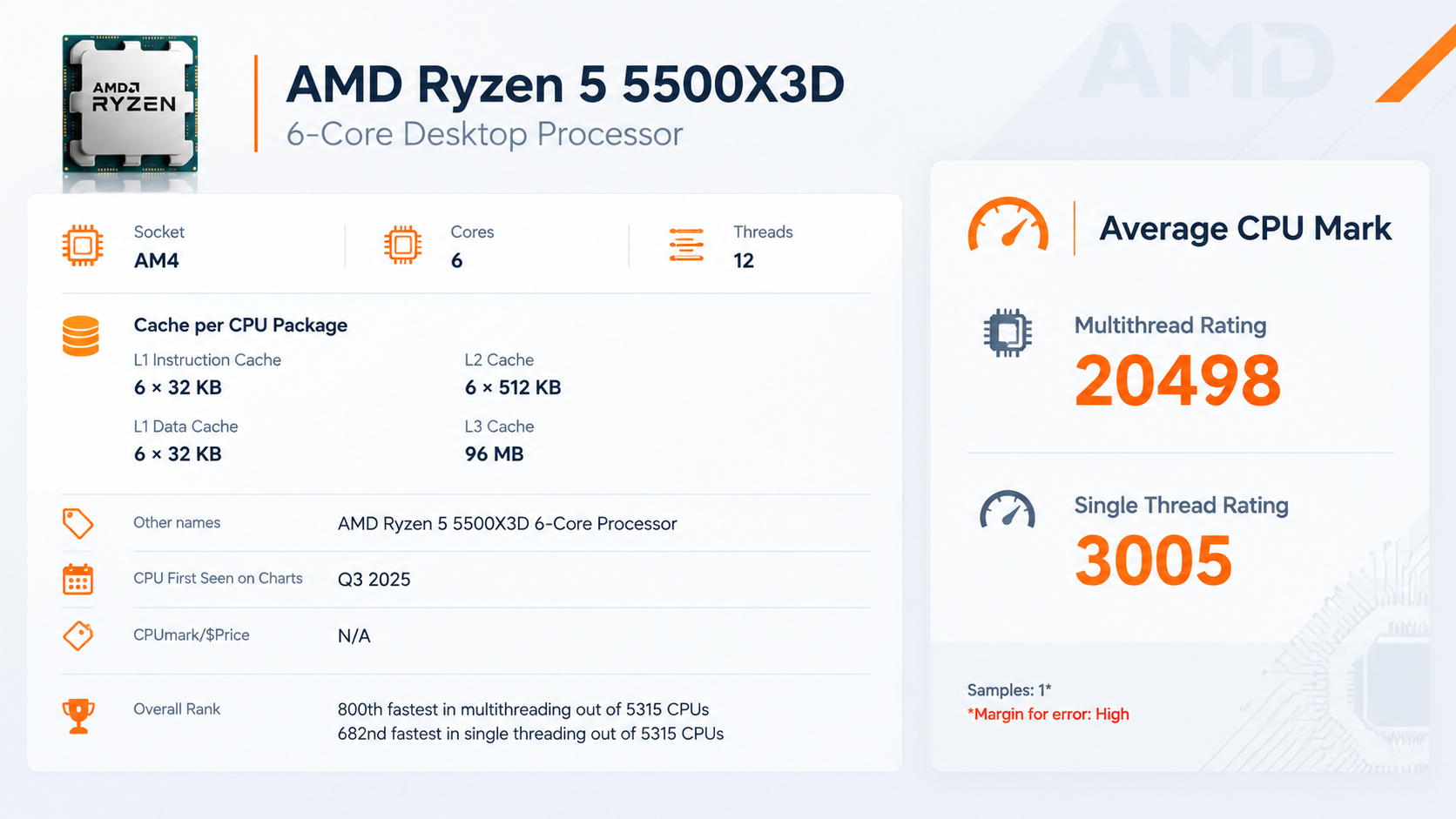
The Ryzen 5 5500X3D uses AMD’s Zen 3 architecture and the AM4 socket. Its key specifications are:
- CPU cores and threads: 6 cores, 12 threads
- Base clock: 3.0GHz
- Maximum boost clock: Up to 4.0GHz
- L3 cache: 96MB
- Default TDP: 105W
- Memory support: DDR4
- Integrated graphics: None; a discrete graphics card is required
These specifications are listed on AMD’s official Ryzen 5 5500X3D product page.
Compared with the standard Ryzen 5 5500, which has 16MB of L3 cache, the 5500X3D offers substantially more cache. This can reduce the need to fetch frequently used game data from system memory, but it does not guarantee a performance improvement in every application.
📊 Early PassMark Results: What the Numbers Show #
Early PassMark results reported for the Ryzen 5 5500X3D included the following scores:
- Single-threaded: 3,005
- Multi-threaded: 20,498
These figures should be treated as preliminary rather than definitive. A benchmark score from a limited number of submissions cannot establish typical performance across different systems, and PassMark does not directly measure gaming frame rates.
The 5500X3D’s lower clock speeds may limit performance in workloads that depend heavily on frequency or sustained throughput. Conversely, its large cache may help in games where frequent memory access is a bottleneck. The balance between these strengths varies by workload, so the processor should not be judged on synthetic scores alone.
🎮 Gaming Performance: Where 3D V-Cache May Help #
The main reason to consider an X3D processor is gaming. A larger L3 cache can keep more game data close to the CPU, potentially reducing memory-access delays and improving performance in cache-sensitive titles.
Games that simulate large worlds, manage many units, or perform frequent CPU-side calculations may benefit. Depending on the game and graphics settings, gains may appear in average frame rates, frame-time consistency, or the lower-percentile results commonly reported as 1% lows.
However, 96MB of cache does not guarantee a particular frame rate or smoother performance in every game. At higher resolutions, the graphics card may become the main bottleneck, reducing the difference between CPUs. The best way to evaluate the 5500X3D is through independent gaming tests using consistent hardware and settings.
The Ryzen 5 5600X3D is a useful point of comparison because it also combines six cores and 12 threads with 96MB of L3 cache. The 5500X3D’s lower clock speeds mean it should not automatically be assumed to match the 5600X3D in gaming.
For rendering, video encoding, and other heavily threaded productivity workloads, higher-clocked processors or CPUs with more cores may offer better value, depending on the software.
🖥️ Extending the Life of AM4 Systems #
One of the 5500X3D’s main attractions is that it can provide an upgrade option for an existing AM4 system. Compatible motherboards using chipsets such as B450, B550, X470, and X570 may support the processor, but support depends on the specific motherboard and BIOS version.
Before buying, check the motherboard manufacturer’s CPU-support list and install a compatible BIOS if required. A firmware update is not a guarantee of better performance, but it may be necessary for the system to recognize and operate the processor correctly.
For existing AM4 owners, the potential advantages include:
- Keeping a compatible motherboard and DDR4 memory.
- Avoiding the additional cost of moving to a new platform.
- Improving gaming performance in cache-sensitive titles without increasing the core count.
- Delaying a full system rebuild if the current graphics card and other components remain adequate.
The upgrade makes the most sense when the processor is competitively priced and the existing system would otherwise require a costly platform replacement.
🌎 Availability and Value #
AMD initially listed the Ryzen 5 5500X3D for the Latin American market. Availability outside that region may vary, so buyers should confirm local stock, warranty coverage, and the final price rather than assume it will receive a broad global release.
Value is especially important for this CPU. If the 5500X3D costs substantially more than a conventional AM4 processor, its gaming advantage needs to justify the premium. Buyers planning to move to AM5 soon should also compare the total cost of a newer CPU, motherboard, and DDR5 memory against the cost of extending their current system’s life.
For related coverage of AMD’s processor lineup, see AMD’s Ryzen 9000-series and APU plans.
📝 Conclusion #
The AMD Ryzen 5 5500X3D gives AM4 users another potential gaming upgrade: six Zen 3 cores, 12 threads, and 96MB of L3 cache in a 105W processor. Its lower clock speeds make it less compelling for some productivity workloads, while the large cache may help in games that benefit from 3D V-Cache.
The early PassMark scores offer an initial performance reference, not a complete picture of gaming capability. For buyers, the deciding factors are independent game benchmarks, motherboard compatibility, regional availability, and price.
For gamers who already own a compatible AM4 system, the 5500X3D could be a practical way to extend its useful life. Whether it is the best-value choice depends on how much it costs compared with other available CPUs and the price of a full platform upgrade.