Introduction to Compilers and Language Design: A Practical Guide
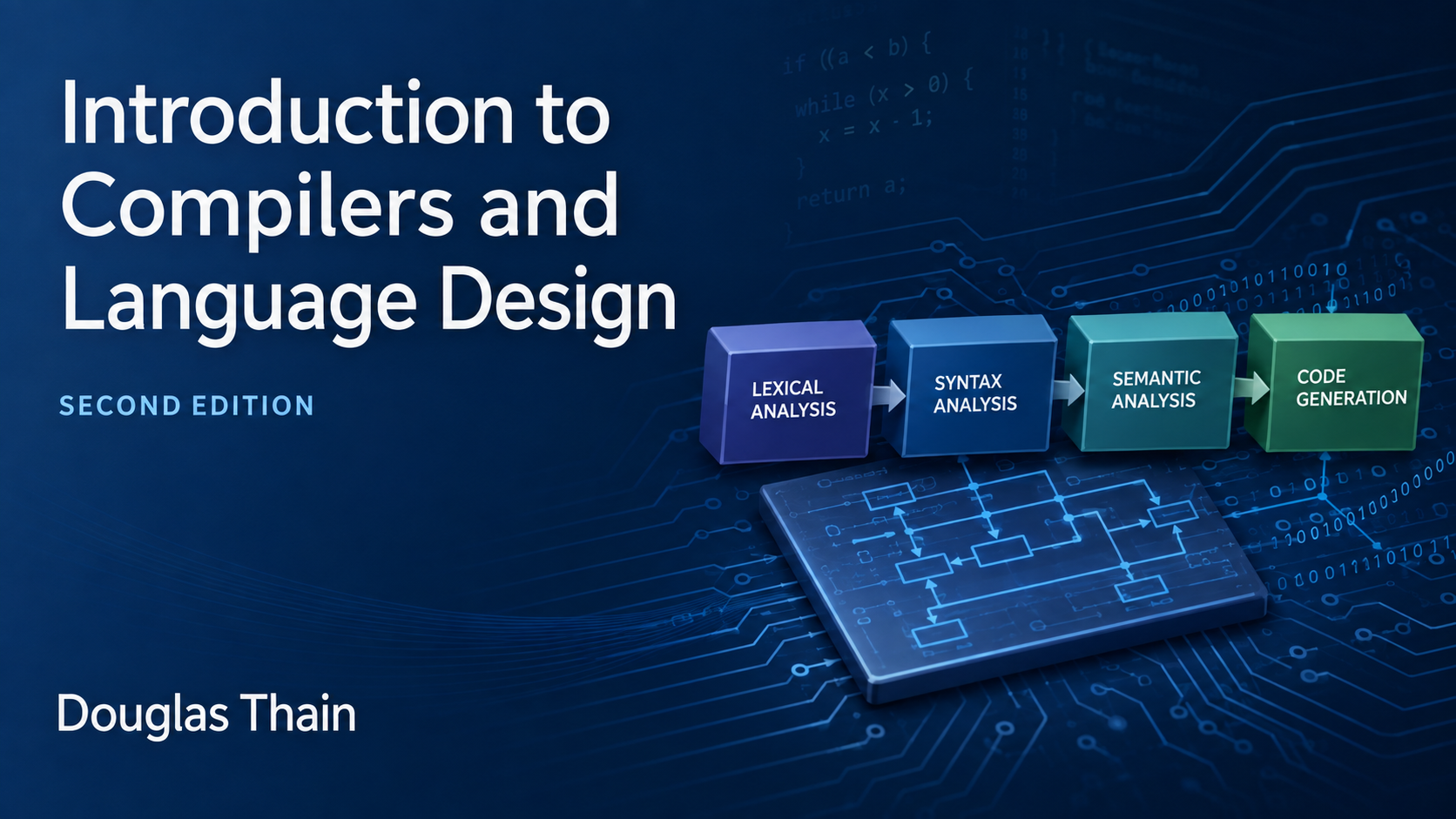
Introduction to Compilers and Language Design
Example code and test cases for the Introduction to Compilers and Language Design
Compiler construction sits at the intersection of programming languages, algorithms, computer architecture, and systems software. For computer science students, building a compiler from scratch provides a practical way to connect these areas into a single engineering project.
Douglas Thain’s Introduction to Compilers and Language Design is designed as a one-semester introduction to compiler construction. The second edition guides readers through the implementation of a simple compiler that accepts a C-like language and generates working x86 or ARM assembly code.
The book combines theoretical concepts with implementation-oriented material, making it particularly suitable for undergraduate students who already have experience programming in C and have completed coursework in data structures and computer architecture.
The online version is currently listed with a revision date of July 26, 2026.
📚 Book Overview #
Introduction to Compilers and Language Design, 2nd edition, was authored by Douglas Thain and published in 2020, with the listed revision date of January 15, 2021 for the edition.
Rather than treating compiler construction purely as a theoretical subject, the book approaches the topic as an end-to-end software engineering project.
What readers build #
The central objective is to construct a working compiler for a small C-like programming language.
The project exposes readers to the major stages of a conventional compiler pipeline, from converting source text into tokens through parsing, semantic analysis, intermediate representation, and ultimately machine-code generation.
The compiler targets x86 or ARM assembly, connecting language-level abstractions directly to the instruction sets and execution models of real processors.
Intended audience #
The book is primarily intended for undergraduate computer science students who already have:
- Experience programming in C
- Familiarity with data structures
- Basic knowledge of computer architecture
- An interest in systems and programming languages
These prerequisites allow the material to focus on compiler-specific concepts rather than introducing fundamental programming techniques from scratch.
🔍 Compiler Construction From Source to Assembly #
A compiler transforms a program written in a high-level programming language into a lower-level representation that can ultimately be executed by a processor.
A simplified pipeline can be represented as:
Source code → Scanning → Parsing → AST → Semantic analysis → Intermediate representation → Code generation → Assembly
Each stage solves a different class of problems.
Scanning #
Scanning, or lexical analysis, converts a sequence of source characters into a stream of tokens.
For example, an expression such as:
x = a + 42;can be decomposed into identifiers, operators, literals, and punctuation.
The scanner establishes the basic lexical structure that subsequent compiler stages consume.
Parsing #
The parser determines whether the token sequence follows the grammar of the language.
It converts a flat token stream into a structured representation reflecting constructs such as expressions, declarations, statements, and function definitions.
Parsing is where the formal grammar of a programming language becomes an executable component of the compiler.
Abstract syntax trees #
The Abstract Syntax Tree, or AST, provides a structured representation of the program’s meaning while removing syntactic details that are unnecessary for later compiler stages.
For example, arithmetic expressions can be represented as hierarchical operator and operand relationships rather than as raw source text.
The AST becomes an important intermediate boundary between parsing and semantic analysis.
Semantic analysis #
Syntactically valid programs are not necessarily semantically valid.
Semantic analysis checks constraints such as type compatibility, variable declarations, scope, and other language-specific rules.
This stage allows the compiler to reject programs that conform to the grammar but violate the language’s semantic requirements.
⚙️ Intermediate Representation and Code Generation #
A compiler typically benefits from separating language-specific analysis from machine-specific code generation.
The book introduces intermediate representation as the layer connecting these two parts of the compiler.
Intermediate representation #
An intermediate representation, or IR, provides a lower-level description of program behavior without being tied completely to a specific processor architecture.
This abstraction makes it easier to reason about transformations and optimization before generating target-specific instructions.
It also provides a clean boundary between the front end of a compiler and its back end.
Memory organization #
Understanding how programs use memory is essential for generating correct machine code.
The book covers memory organization and the relationship between high-level language constructs and lower-level storage mechanisms.
Topics such as variables, stack organization, function calls, and data representation become particularly important when translating a C-like language into assembly.
Assembly language #
The transition to assembly exposes the architectural details hidden by high-level languages.
Readers learn how compiler-generated instructions represent operations expressed much more abstractly in source code.
This makes computer architecture concepts directly relevant to compiler implementation.
Code generation #
Code generation converts the compiler’s intermediate representation into target assembly instructions.
The book focuses on producing working x86 or ARM assembly, allowing readers to see the complete path from source-level constructs to executable machine-level operations.
This stage ties together the earlier components of the compiler pipeline.
🚀 Optimization and Compiler Engineering #
Once a compiler can correctly translate programs, optimization becomes the next major challenge.
Optimization attempts to improve characteristics such as execution speed, code size, or resource utilization without changing program behavior.
The book introduces optimization after the fundamental compiler pipeline has been established, providing a natural progression from correctness to performance.
Correctness comes before optimization #
A useful compiler-development principle is that optimization should not obscure the correctness of the basic translation pipeline.
A compiler that produces fast but incorrect programs is not useful.
By first implementing scanning, parsing, semantic analysis, IR generation, and code generation, students can establish a working baseline before introducing transformations that make generated code more efficient.
This mirrors the development of production compiler systems, where correctness, testing, intermediate representations, and optimization passes form distinct but interconnected concerns.
🗂️ Complete Chapter Structure #
The second edition covers the major components required to construct a functional compiler.
| Chapter | Topic |
|---|---|
| Chapter 0 | Front Matter |
| Chapter 1 | Introduction |
| Chapter 2 | A Quick Tour |
| Chapter 3 | Scanning |
| Chapter 4 | Parsing |
| Chapter 5 | Parsing in Practice |
| Chapter 6 | The Abstract Syntax Tree |
| Chapter 7 | Semantic Analysis |
| Chapter 8 | Intermediate Representation |
| Chapter 9 | Memory Organization |
| Chapter 10 | Assembly Language |
| Chapter 11 | Code Generation |
| Chapter 12 | Optimization |
The book also includes several appendices that support implementation and course usage.
| Appendix | Topic |
|---|---|
| Appendix A | Sample Course Project |
| Appendix B | The B-Minor Language |
| Appendix C | Coding Conventions |
🧪 B-Minor Provides a Concrete Compiler Project #
The inclusion of the B-Minor language gives the book a concrete target for the compiler implementation.
A deliberately constrained language is useful for educational compiler construction because it keeps the scope manageable while preserving the essential challenges found in larger languages.
Students can therefore implement a complete compilation pipeline without having to reproduce the enormous feature set of languages such as C++, Java, or Rust.
Why a small language is useful #
A compact language allows students to focus on the core mechanisms behind compiler construction:
- Lexical analysis
- Context-free grammars
- Parse trees and ASTs
- Symbol tables
- Type checking
- Intermediate representations
- Stack and memory organization
- Assembly generation
- Optimization
These concepts transfer directly to larger language implementations.
🎓 A Practical Introduction to Compiler Design #
Compiler construction is often considered one of the subjects where computer science theory and practical engineering meet most directly.
Formal grammars explain parsing. Data structures support syntax trees and symbol tables. Type systems govern semantic analysis. Computer architecture determines how high-level operations become machine instructions. Optimization combines algorithms and architectural knowledge to improve generated code.
Thain’s book organizes these topics around a single practical objective: building a compiler that actually works.
For students with a foundation in C, data structures, and computer architecture, this approach can make compiler design significantly more tangible than studying individual compiler components in isolation.
🔗 Access and Usage #
The author permits the provided PDFs to be downloaded, printed, and used for personal and academic purposes. Commercial printing or distribution is prohibited.
The recommended approach for instructors is to direct students to the official book website so they can access the latest online revision rather than distributing locally copied PDFs.
The online version is currently listed as revised on July 26, 2026.
🔭 Why This Book Remains Relevant #
Modern software developers increasingly work with compilers, interpreters, virtual machines, domain-specific languages, JIT runtimes, and language tooling. Understanding how source code moves through lexical analysis, parsing, semantic analysis, intermediate representations, and code generation provides valuable insight into all of these systems.
The practical compiler project in Introduction to Compilers and Language Design offers a compact way to acquire that understanding.
By the end of the material, readers have not merely studied how compilers work. They have followed the complete engineering path from a C-like source language to executable x86 or ARM assembly, including the intermediate structures and transformations required along the way.
For anyone looking for a structured introduction to compiler construction, programming-language implementation, or systems-oriented software engineering, the book provides a strong foundation for exploring the field in considerably greater depth.