BlackBerry Expands Beyond Automotive with QNX Software Platform
BlackBerry continues to reshape its identity as a software-first company, leveraging its QNX real-time operating system (RTOS) as the foundation for a growing portfolio of mission-critical infrastructure solutions.
During an interview on Bloomberg Open Interest, BlackBerry CEO John Giamatteo discussed the company’s strategic evolution from a smartphone pioneer to a provider of embedded software powering vehicles, industrial systems, robotics, and medical devices. He also highlighted QNX’s expanding role in enabling the next generation of connected and autonomous technologies.
🚗 QNX Powers More Than 275 Million Vehicles #
QNX remains BlackBerry’s flagship software platform and one of the world’s most widely deployed real-time operating systems for the automotive industry.
According to Giamatteo, the platform is now embedded in more than 275 million vehicles worldwide, supporting a wide range of automotive functions, including:
- Digital instrument clusters
- Infotainment systems
- Advanced driver assistance systems (ADAS)
- Domain and zonal controllers
- Vehicle gateways
- Autonomous driving platforms
The platform’s reputation for reliability, security, and deterministic performance has made it a preferred operating system for safety-critical automotive applications.
As software-defined vehicles continue to gain momentum, QNX is expected to remain a key component of modern vehicle architectures.
🤖 Expanding Beyond the Automotive Industry #
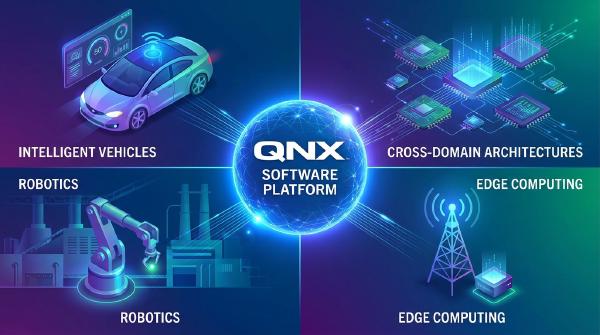
While automotive remains BlackBerry’s largest market, Giamatteo emphasized that QNX is increasingly being adopted across multiple industries that require dependable real-time computing.
The operating system is seeing broader deployment in areas such as:
- Robotics
- Medical devices
- Industrial automation
- Embedded edge computing
- Critical infrastructure systems
These industries share similar requirements for low-latency operation, high availability, functional safety, and long-term software support—areas where real-time operating systems provide significant advantages over general-purpose operating systems.
⚙️ Why Real-Time Operating Systems Matter #
Unlike conventional desktop or mobile operating systems, a real-time operating system (RTOS) is designed to guarantee predictable execution timing for critical workloads.
This deterministic behavior is essential for applications where delays or unexpected system behavior could compromise safety, reliability, or operational performance.
Typical characteristics of an RTOS include:
- Deterministic task scheduling
- Low-latency interrupt handling
- High system reliability
- Functional safety support
- Long lifecycle maintenance
- Strong security architecture
These capabilities have made QNX a trusted platform in industries where system failures are unacceptable.
🏭 Growth Opportunities in Industrial Digitalization #
BlackBerry sees significant opportunities as industries accelerate digital transformation and deploy increasingly intelligent connected systems.
Manufacturing facilities, industrial robots, autonomous mobile platforms, and edge computing devices are all becoming more software-driven, creating demand for operating systems capable of managing complex real-time workloads.
Medical technology is another expanding market, where embedded software supports devices that require continuous operation, regulatory compliance, and dependable performance.
By extending QNX into these adjacent sectors, BlackBerry aims to diversify its revenue beyond automotive while capitalizing on long-term trends in industrial automation and intelligent infrastructure.
🌐 From Device Manufacturer to Software Infrastructure Provider #
Giamatteo’s remarks reflect BlackBerry’s broader strategic transformation over the past decade.
Rather than competing in consumer hardware, the company has repositioned itself as a provider of foundational software for mission-critical systems.
Its strategy now centers on delivering technologies that support:
- Embedded operating systems
- Software-defined vehicles
- Connected infrastructure
- Intelligent edge devices
- Industrial digital transformation
- Secure mission-critical computing
This shift aligns BlackBerry with growing demand for embedded software platforms that serve as the backbone of modern connected systems across multiple industries.
📈 Outlook #
As industries increasingly adopt autonomous systems, connected devices, and software-defined architectures, demand for reliable real-time operating systems is expected to continue growing.
With QNX already deployed in more than 275 million vehicles and expanding into robotics, healthcare, and industrial automation, BlackBerry is positioning itself as a long-term software infrastructure provider rather than a traditional hardware company.
The company’s continued investment in QNX reflects a strategy focused on enabling safety-critical, high-reliability computing across a broad range of embedded applications, supporting the next generation of intelligent and connected systems.