BlackBerry’s Software Pivot: QNX Growth and Long-Term Investment Thesis
For many investors, the BlackBerry brand remains psychologically anchored to its failed smartphone era. That legacy perception continues to distort how the market evaluates the company today.
Modern BlackBerry is no longer a consumer hardware company. The transition away from handsets, licensing distractions, and legacy consumer products is effectively complete. What remains is a significantly smaller but far more focused software business built around two strategically valuable assets:
- QNX, a real-time embedded operating system platform
- A Secure Communications division serving government and defense customers
The transformation is no longer theoretical. Financially and operationally, BlackBerry has already crossed the difficult phase of restructuring and stabilization. The remaining question is not whether the turnaround survives — it is whether the company can convert operational discipline into sustainable software growth.
🚗 The Reinvention of BlackBerry #
BlackBerry’s pivot toward enterprise software and embedded systems took years longer than many investors expected, largely because the company spent an extended period unwinding its legacy identity.
That process included:
- Exiting smartphone manufacturing
- Divesting hardware operations
- Rationalizing non-core assets
- Reducing operating expenses
- Restructuring business units
- Simplifying the balance sheet
The result is a business with:
- Improved operating efficiency
- Positive cash generation
- Reduced legacy liabilities
- Greater strategic clarity
Importantly, the current BlackBerry is no longer attempting to compete across multiple unrelated markets. The company now revolves around software infrastructure and secure embedded systems.
🧠 QNX: The Core Strategic Asset #
The most important piece of the company is unquestionably QNX.
QNX is a real-time operating system (RTOS) designed for embedded, safety-critical environments where reliability and deterministic behavior are mandatory.
Unlike consumer software platforms, embedded operating systems in automotive and industrial systems are exceptionally difficult to replace once deployed.
Why QNX Matters #
QNX is not commodity infrastructure.
Embedded operating systems used in safety-certified environments require:
- Functional safety validation
- Regulatory certifications
- Long-term support commitments
- Deterministic scheduling
- High reliability under failure conditions
These requirements create significant barriers to entry.
Once an automotive platform or industrial system adopts a certified RTOS, switching costs become extremely high because replacing the software stack often requires:
- Multi-year revalidation
- Safety recertification
- Extensive integration testing
- Vendor retraining
- Architectural redesign
This creates unusually durable customer relationships.
🚘 Automotive Software as a Long-Term Growth Driver #
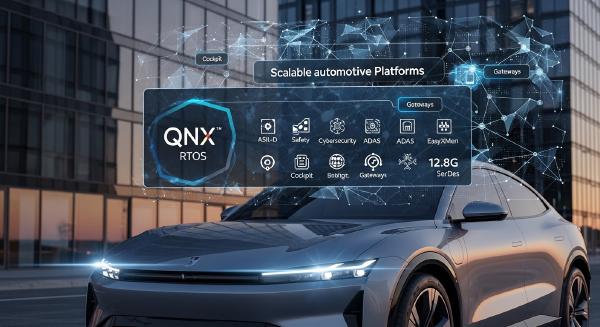
The automotive market is the primary growth engine behind the QNX investment thesis.
Modern vehicles are rapidly evolving into software-defined platforms with increasing computational complexity across:
- Digital cockpits
- ADAS systems
- Autonomous driving modules
- Vehicle networking
- Infotainment systems
- Real-time safety controllers
As vehicles incorporate more software functionality, the importance of stable embedded operating systems increases substantially.
Expanding Role Inside the Vehicle Stack #
Historically, embedded operating systems handled relatively narrow functions inside automotive systems.
That scope is expanding.
QNX is increasingly positioned to manage:
- Hypervisors
- Domain controllers
- Middleware coordination
- Safety partitioning
- Mixed-criticality workloads
This matters because platform expansion inside existing vehicle architectures can drive revenue growth even without dramatic increases in customer count.
The opportunity is not merely more vehicles — it is deeper software penetration per vehicle.
🤖 Robotics and Industrial Automation Opportunity #
Beyond automotive, robotics represents a potentially significant long-term growth vector.
Industrial and commercial robotics systems increasingly require:
- Real-time scheduling
- Deterministic control
- Functional safety
- Fault isolation
- Secure edge computing
These are environments where general-purpose operating systems often struggle.
Why RTOS Platforms Matter in Robotics #
Autonomous machines operate under strict latency and reliability requirements.
Examples include:
- Warehouse robotics
- Industrial automation
- Autonomous mobile robots
- Medical systems
- Defense robotics
- Smart manufacturing equipment
In these environments, software failure is not merely inconvenient — it can become a safety or operational hazard.
QNX’s architecture is naturally aligned with these workloads because it was built for:
- Embedded determinism
- High availability
- Fault containment
- Mission-critical execution
The robotics market remains earlier-stage than automotive, but the long-term addressable opportunity could ultimately become larger.
🔐 Secure Communications: Stable but Not Transformational #
BlackBerry’s Secure Communications division serves a very different role within the business.
Unlike QNX, this segment is not primarily a growth engine.
Instead, it functions as a stable, recurring revenue contributor focused on:
- Government agencies
- Defense organizations
- Regulated industries
- Security-sensitive communications
Characteristics of Government-Focused Software Markets #
Government and defense customers prioritize:
- Reliability
- Certification
- Continuity
- Security assurance
- Vendor trust
Innovation speed is often less important than operational stability.
As a result, these markets tend to generate:
- Long deployment cycles
- Slow customer turnover
- Predictable renewals
- Durable contracts
While the Secure Communications segment is unlikely to command premium growth multiples independently, it contributes financial stability and supports the broader software platform.
📉 Cost Discipline Versus Growth Execution #
Management deserves substantial credit for stabilizing the business.
The turnaround required difficult operational decisions, including:
- Cost reduction
- Organizational restructuring
- Asset divestitures
- Strategic narrowing of focus
Those actions materially improved the company’s financial profile.
However, operational efficiency and growth execution are fundamentally different challenges.
The Key Strategic Question #
The central investment question is now:
Can BlackBerry convert operational stabilization into sustained organic software growth?
This requires a different organizational capability set.
Scaling QNX adoption across:
- New automotive programs
- Robotics deployments
- Industrial automation systems
demands:
- Strong ecosystem partnerships
- OEM integration success
- Platform innovation
- Long sales-cycle execution
- Competitive technical differentiation
Cost optimization alone cannot produce durable revenue expansion.
📊 How the Market Will Likely Value BlackBerry #
The stock’s future valuation increasingly depends on whether investors classify BlackBerry as:
- A mature restructuring story or
- A scalable embedded software platform
That distinction matters enormously for valuation multiples.
What Drives Multiple Expansion #
Software companies receive premium valuations when investors believe they possess:
- Durable competitive advantages
- Expanding TAMs
- Recurring revenue visibility
- Strong platform positioning
- Long-term organic growth
For BlackBerry, that narrative depends primarily on QNX.
If the company demonstrates:
- Expanding automotive software penetration
- Robotics adoption growth
- Higher recurring software revenue
- Sustainable design-win momentum
the market may increasingly treat BlackBerry as a strategic embedded software platform rather than a legacy turnaround.
⚠️ Risks to the Investment Thesis #
Several important risks remain.
Automotive Industry Cyclicality #
Automotive production cycles can materially impact software deployment timing.
Competitive Pressure #
BlackBerry competes against:
- Linux-based embedded platforms
- Automotive middleware vendors
- Proprietary OEM solutions
- Emerging edge operating systems
Long Sales Cycles #
Embedded systems adoption often requires:
- Multi-year qualification periods
- Regulatory approvals
- Platform integration timelines
This can delay visible revenue acceleration.
Execution Risk #
The company must prove it can translate technological positioning into:
- Scalable commercial growth
- Consistent design wins
- Broader ecosystem adoption
Without sustained revenue expansion, the stock may remain trapped in a restructuring valuation framework.
🌍 Why QNX Remains Strategically Relevant #
Despite the rise of cloud-native software and AI-centric narratives, embedded real-time operating systems remain foundational infrastructure for physical computing systems.
As industries move toward:
- Autonomous systems
- Edge intelligence
- Connected vehicles
- Industrial automation
- Smart infrastructure
the demand for reliable embedded operating systems is likely to increase rather than diminish.
This is particularly true in environments where:
- Downtime is unacceptable
- Latency matters
- Safety certification is required
- Reliability directly affects physical systems
QNX operates precisely within that category.
📌 Conclusion #
BlackBerry’s transformation into a focused software company is far more advanced than many market participants acknowledge.
The company has already completed much of the difficult restructuring work:
- Legacy hardware operations are gone
- The balance sheet is cleaner
- Operating discipline has improved
- Profitability and cash generation have stabilized
The remaining challenge is growth.
QNX represents the central strategic asset and the primary reason the company still matters in the modern software landscape. Its position within automotive embedded systems and emerging robotics infrastructure creates a credible long-term growth narrative built on high switching costs and safety-critical software expertise.
The Secure Communications business adds stability, but the long-term valuation story depends overwhelmingly on whether QNX can expand its footprint across next-generation embedded platforms.
The turnaround phase is largely complete. What comes next is the more difficult stage: proving that BlackBerry is not merely a surviving software company, but a growing one.