QNX and Vector Launch Alloy Kore for SDV Development
QNX, a business unit of BlackBerry Limited, and Vector have announced Alloy Kore, a new Foundational Vehicle Software Platform designed to simplify and accelerate the development of Software-Defined Vehicles (SDVs).
As automotive software architectures become increasingly centralized and complex, OEMs must integrate operating systems, virtualization, middleware, cybersecurity, functional-safety mechanisms, and vehicle services into a maintainable platform.
Alloy Kore is intended to provide a reusable software foundation for these requirements, allowing automotive engineering teams to focus more of their development effort on vehicle-specific and brand-differentiating functionality.
An Early Access version is available for evaluation and integration, while the fully certified release is planned for late 2026.
🚗 Alloy Kore as a Foundational Software Platform #
Modern SDV architectures increasingly rely on centralized, high-performance computing rather than isolated software stacks for individual electronic control units.
This architectural shift introduces a significant integration challenge. OEMs need to combine multiple software layers while maintaining predictable behavior, functional safety, cybersecurity, updateability, and long-term maintainability.
Alloy Kore addresses this foundational layer by combining:
- QNX’s safety-certified real-time operating system and virtualization technologies
- Vector’s automotive middleware and software technologies
- A reusable platform architecture intended for multiple vehicle applications
- Support for centralized automotive computing architectures
- A foundation designed around functional-safety and cybersecurity requirements
The goal is to reduce the amount of foundational software that OEM engineering teams must repeatedly integrate and validate for each vehicle program.
⚙️ Early Access and OEM Evaluation #
The Early Access program allows participating organizations to prototype Alloy Kore, perform integration testing, and provide feedback before the certified release.
Mercedes-Benz is among the automakers evaluating the platform for next-generation SDV programs.
The platform is also designed to support centralized computing architectures and fleet-wide Over-the-Air (OTA) software updates. This separation between hardware and software development can allow vehicle software to evolve independently after the underlying computing platform has been deployed.
John Wall, President of QNX, described the platform’s objective as addressing foundational software complexity so OEM engineering teams can concentrate on differentiated functionality, including advanced driver assistance, intelligent vehicle automation, and cockpit experiences.
The planned certified platform is targeted at automotive requirements including:
- Functional safety: ISO 26262, including ASIL D requirements
- Cybersecurity: ISO/SAE 21434
- Software lifecycle and integration requirements for SDV architectures
- Long-term software maintenance and updateability
The distinction between the current Early Access version and the planned certified release is important: certification claims should be evaluated against the final product and its applicable safety scope.
🌐 Building an Open SDV Ecosystem #
QNX and Vector position Alloy Kore as more than a standalone software package. The companies describe it as a potential industry reference architecture for foundational vehicle software.
The approach is intended to support collaboration among automotive OEMs, commercial-vehicle manufacturers, technology suppliers, and industry organizations.
Instead of rebuilding a foundational software stack for every vehicle program, OEMs can potentially reuse common platform components and concentrate engineering resources on applications and services that differentiate individual vehicle products.
A modular foundation can also help standardize interfaces between the underlying vehicle platform and higher-level applications, making future software integration and maintenance more manageable.
🔄 Centralized Computing and OTA Updates #
One of the key architectural trends behind platforms such as Alloy Kore is the transition from distributed ECU architectures toward centralized or zonal vehicle computing.
In a traditional architecture, individual ECUs often contain their own processor, operating environment, middleware, and application software. Centralized SDV architectures instead consolidate computing resources and separate common platform services from vehicle-specific applications.
This creates several potential benefits:
- Reduced software duplication across vehicle domains.
- Reusable platform components across vehicle programs.
- Simplified software integration on centralized compute nodes.
- More flexible software updates after vehicle deployment.
- Clearer separation between foundational services and differentiated applications.
OTA capability is particularly important in this model because software functionality can continue to evolve throughout a vehicle’s operational lifetime.
🛡️ Functional Safety and Cybersecurity #
Safety and cybersecurity are fundamental requirements for production automotive software.
For safety-critical systems, ISO 26262 provides a framework for managing functional-safety risks throughout the development lifecycle. Alloy Kore’s planned certified release is intended to address requirements up to ASIL D, the highest Automotive Safety Integrity Level defined by ISO 26262.
Cybersecurity is addressed through the automotive cybersecurity framework defined by ISO/SAE 21434.
These standards address different engineering concerns:
| Area | Standard | Primary focus |
|---|---|---|
| Functional safety | ISO 26262 | Managing hazards and safety risks |
| Cybersecurity | ISO/SAE 21434 | Managing cybersecurity risks |
| Vehicle software platform | Alloy Kore | Foundational software integration |
Certification should therefore be understood as part of a broader vehicle development process rather than as a substitute for system-level safety and cybersecurity engineering.
🎤 Alloy Kore at CES 2026 #
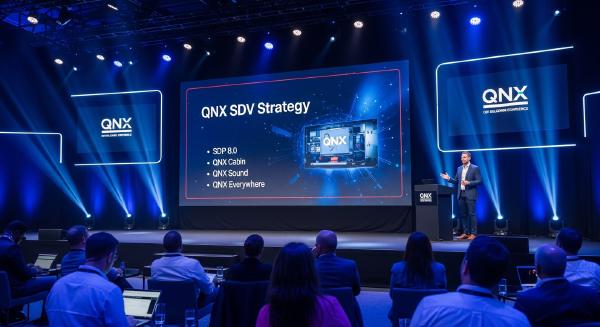
QNX presented Alloy Kore and related SDV technologies at CES 2026 in Las Vegas.
- Event: CES 2026
- Dates: January 6–9, 2026
- Venue: Las Vegas Convention Center, West Hall
- Booth: #4024
The event provided an opportunity to demonstrate the platform and discuss its role in next-generation software-defined vehicle architectures.
🏢 About QNX and Vector #
QNX, a business unit of BlackBerry Limited, develops real-time operating systems, hypervisors, and other software technologies for safety-critical and embedded systems. Its technology is widely used in automotive and other industries where reliability, determinism, and certification are important.
Vector, founded in 1988 and headquartered in Stuttgart, Germany, develops software tools and technologies for automotive electronics and embedded systems. The company operates internationally and provides development solutions covering areas such as automotive networking, diagnostics, AUTOSAR, testing, and embedded software.
🧠 Conclusion #
Alloy Kore reflects a broader shift in automotive software architecture: OEMs are increasingly looking for reusable foundational platforms rather than building every layer of the vehicle software stack independently for each program.
By combining QNX’s real-time operating system and virtualization capabilities with Vector’s automotive software technologies, Alloy Kore is designed to provide a common foundation for centralized SDV computing.
The Early Access program provides an opportunity for OEMs and other participants to evaluate the platform before the planned fully certified release in late 2026. Its longer-term significance will depend on how effectively the platform integrates with production vehicle architectures, development workflows, safety processes, cybersecurity requirements, and the broader SDV ecosystem.