QNX Containers: OCI Containerization for Safety-Critical Embedded Systems
Embedded software is becoming increasingly complex as industries embrace software-defined architectures, artificial intelligence, and continuous software delivery. Automotive platforms now receive over-the-air (OTA) updates, industrial robots execute AI inference alongside deterministic control loops, and medical devices must isolate safety-critical functions from user-facing applications.
Meeting these requirements with traditional embedded software deployment models is becoming increasingly difficult. Monolithic system images slow development, complicate maintenance, and make targeted software updates nearly impossible.
QNX Containers addresses these challenges by introducing a lightweight, Open Container Initiative (OCI)-compliant container runtime designed specifically for QNX SDP 8.0. It enables modern containerized application deployment while preserving the deterministic behavior, reliability, and security expected from safety-critical real-time systems.
🚀 Why Containerization Matters for Embedded Systems #
Modern embedded applications are rarely built as a single executable. Development teams increasingly rely on independently developed services, third-party software, and modular architectures that evolve throughout a product’s lifecycle.
Traditional embedded deployment models package every application and dependency into a single firmware image. While functional, this approach presents several challenges:
- Tight coupling between software components
- Complex dependency management
- Lengthy integration and validation cycles
- Large firmware updates for minor application changes
- Limited flexibility for OTA deployments
Containers solve these issues by packaging applications together with their runtime dependencies, allowing software to execute consistently across development, testing, and production environments.
Unlike virtual machines, containers share the host operating system kernel, eliminating guest OS overhead while maintaining lightweight isolation.
QNX Containers extends this cloud-native deployment model to deterministic embedded systems without sacrificing the real-time characteristics that define the QNX operating system.
🏗️ Containerization Designed for Real-Time Systems #
Rather than deploying entire firmware images for every software revision, QNX Containers enables applications to be delivered as self-contained deployment units.
This architecture allows developers to:
- Package applications independently
- Clearly separate software components
- Update individual applications without replacing the entire system image
- Maintain a consistent development workflow from cloud infrastructure to embedded edge devices
The result is a more modular software architecture that reduces integration complexity while simplifying long-term maintenance.
Core Capabilities #
QNX Containers provides a modern container platform with features tailored for embedded deployments, including:
- Native container runtime for QNX SDP 8.0
- Full compatibility with OCI image specifications
- Docker-compatible image workflows
- Support for standard container registries
- Foundation for future Kubernetes integration through planned Container Runtime Interface (CRI) alignment
By adopting open standards, organizations can leverage existing container tooling while minimizing vendor lock-in.
⚙️ Key Benefits #
Simplified Application Packaging #
Each container bundles only the binaries, shared libraries, and runtime dependencies required by a specific application.
This reduces dependency conflicts, simplifies integration, and enables multiple applications with different software stacks to coexist on the same platform.
Faster Development Pipelines #
Development teams can reuse familiar Docker-based workflows together with modern CI/CD pipelines.
Standardized container images improve build reproducibility while accelerating testing, deployment, and software validation across development environments.
Workload Isolation #
Containers provide logical separation between applications, making it practical to run heterogeneous workloads on a single device.
Examples include:
- Real-time control software
- Human-machine interface (HMI) applications
- AI inference services
- Data logging and analytics
- Third-party applications
Each workload operates within its own isolated execution environment while sharing the underlying QNX kernel.
Efficient OTA Updates #
Rather than distributing complete firmware images, organizations can deploy only the containers that have changed.
This approach reduces update sizes, minimizes deployment downtime, and simplifies fleet management for connected devices.
🧩 Architecture Overview #
QNX Containers consists of three primary software components running on the QNX host operating system.
qcmctl #
qcmctl provides the command-line interface used to manage container images, pods, and running containers directly on the target device.
Developers can perform common lifecycle operations such as:
- Pulling images
- Starting containers
- Stopping workloads
- Managing pods
- Inspecting container status
qcmgr #
qcmgr serves as the container management service responsible for:
- Image management
- Container lifecycle orchestration
- Resource coordination
- Communication with the runtime
It acts as the central control plane for container operations on the device.
qrunc #
qrunc is the OCI-compliant runtime responsible for creating and managing isolated execution environments.
It handles low-level container creation while preserving the deterministic scheduling behavior of the underlying QNX microkernel.
Together, these components provide a standards-based container platform optimized for embedded deployments.
🔒 Security and Deterministic Performance #
Security is a primary design objective for QNX Containers, particularly in industries requiring functional safety and cybersecurity compliance.
Built-in isolation mechanisms include:
- Filesystem isolation using
chroot - Network isolation through QNX Network Jails
- UID/GID-based access controls
- Integration with QNX security policies
- Compliance with ISO/SAE 21434 automotive cybersecurity requirements
Unlike traditional virtualization technologies, containerization introduces minimal runtime overhead because all containers share the host operating system kernel.
This architecture provides several performance advantages:
- Base container images as small as approximately 4 MB
- No guest operating system overhead
- Low memory consumption
- Full preservation of QNX real-time determinism
- Fast application startup
These characteristics make QNX Containers suitable for resource-constrained embedded platforms where latency and predictable execution remain critical.
🌐 Practical Applications #
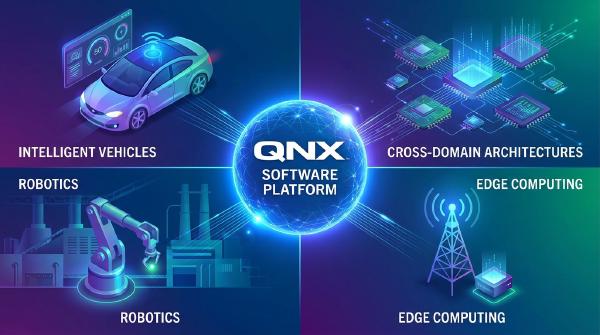
The flexibility of OCI-based containerization enables deployment across numerous safety-critical industries.
Automotive #
Software-defined vehicles increasingly require modular software deployment.
QNX Containers supports:
- OTA feature delivery
- Third-party application deployment
- AI cockpit services
- Domain controller applications
- Continuous software updates
Industrial Automation #
Industrial control systems benefit from modular software architectures that simplify maintenance while improving interoperability between equipment vendors.
Containers also reduce the complexity of deploying updated analytics and monitoring services without disrupting deterministic control software.
Robotics #
Modern robots often combine deterministic motion control with computationally intensive perception workloads.
Containers simplify deployment of:
- Computer vision
- Sensor fusion
- AI inference
- Navigation services
- Edge analytics
while maintaining isolation between safety-critical and non-critical software components.
Medical Devices #
Medical systems frequently require strict separation between regulated software and auxiliary applications.
Containerized deployment enables stronger isolation while simplifying software maintenance and future feature expansion.
📦 Platform Availability #
QNX Containers is currently available for QNX SDP 8.0 and supports both:
- x86_64
- AArch64
Current capabilities include:
- OCI-compliant runtime
- OCI image support
- Local and remote registry integration
- Single-node container lifecycle management
- On-device command-line management tools
Future enhancements are expected to further expand orchestration capabilities while maintaining compatibility with established OCI ecosystem standards.
📖 Conclusion #
QNX Containers modernizes software deployment for safety-critical embedded systems by combining cloud-native container technologies with the deterministic behavior of the QNX microkernel.
Through OCI compliance, lightweight isolation, and seamless integration with existing container tooling, developers can build modular applications, accelerate CI/CD workflows, simplify OTA updates, and deploy heterogeneous workloads without compromising reliability, real-time performance, or security.
As software-defined products continue to reshape industries such as automotive, industrial automation, robotics, and healthcare, containerization is becoming an essential architectural building block. QNX Containers provides a standards-based path toward scalable, maintainable, and future-ready embedded software platforms while preserving the functional safety and operational integrity required by mission-critical applications.